
Your Trade and Craft Workforce Is Your Biggest Asset -- But also Your Biggest Blind Spot

Posted on April 30, 2026
Large industrial contractors manage thousands of trade workers across dozens of job sites and multiple states. But ask an ops leader where their workers are, who's available, who's certified for what, and what is happening on the job. Suddenly you're making 15 phone calls. The lack of a system of record for your workforce is the problem.
The Invisible Workforce
Consider a large infrastructure contractor with more than 5000 employees, multiple business segments spanning multiple trade groups telecom, clean energy, civil infrastructure, etc. Operations spread across a dozen states. Hundreds of active projects at any given time.
Each segment has its own crews. Each crew has its own foremen. Each foreman has their own mental model of who can do what. That institutional knowledge lives in people's heads, in spreadsheets that are six months out of date, and in group texts that disappear after a project wraps.
Now multiply that across business units. The electrical transmission division has linemen with HV certifications. The pipeline group has welders with specific procedure qualifications. The clean energy team has wind techs with GWO and OSHA credentials. The office? See's very little of it. That's not a technology gap. That's a data gap. And it's costing contractors real money — in overtime, in underutilization, in misdeployment (not to mention the compliance risk of putting the wrong person on the wrong job).
Why Traditional Approaches Fail
Most large contractors have tried to solve this. They've bought HRIS systems, workforce management platforms, scheduling tools. The software exists. The data doesn't.
Here's why: field workers don't use apps.
It doesn't matter how good the dashboard is if the lineman on a transmission tower doesn't open the app. It doesn't matter how sophisticated your skills matrix is if the foreman fills it out once during onboarding and never updates it. Every workforce platform in construction has the same adoption problem — the people with the most valuable information (the workers and their supervisors) are the least likely to interact with the system.
So you end up with two things: a beautiful platform that ops bought and is paying for, and a parallel reality where dispatchers still call crew leads every morning to figure out who's available.
The Communication First Approach to Building a Workforce Database
What if you could build your workforce database through the channels your crews already use every day — calls and texts in the workers preferred language.
That's what a voice-first approach looks like in practice:
Skills and Certification Capture
A voice agent calls a worker and has a natural conversation: "Hey, I'm updating our records — do you still have your OSHA 30? When does it expire? What about your CDL — is that current?"
The call takes 3 minutes. The data gets structured and stored automatically with a worker profile, no forms, no logins, no app downloads.
Certifications like NCCER welding procedures, DOT operator qualifications, crane operator credentials, HV electrical certs, confined space, rigging — all captured through voice and organized into a searchable, filterable database.
Ongoing Updates via Text
When a worker earns a new certification, they can text a photo of the card. Done.
When a crew lead finishes a training module with their team, a quick text updates the system.
Expiring certs trigger automated outreach — a text or call to the worker asking them to confirm renewal status.
The Result For the first time, you have a live, accurate database of your entire trade workforce — skills, certifications, availability, location, experience — updated continuously without requiring anyone to log into anything. Not a snapshot from onboarding. Not a spreadsheet from six months ago. A living record.
From Database to Dispatch: Scheduling and Allocation
Once you have the database, the real leverage kicks in.
Skills-Based Deployment Instead of the dispatcher calling around to find someone qualified, the system already knows. Need 4 journeyman linemen with HV certs and CDLs for a transmission project in West Texas? Use the Gild chat agent, Forge to find: who's available, who's certified, who's closest, who's coming off their current project soonest.
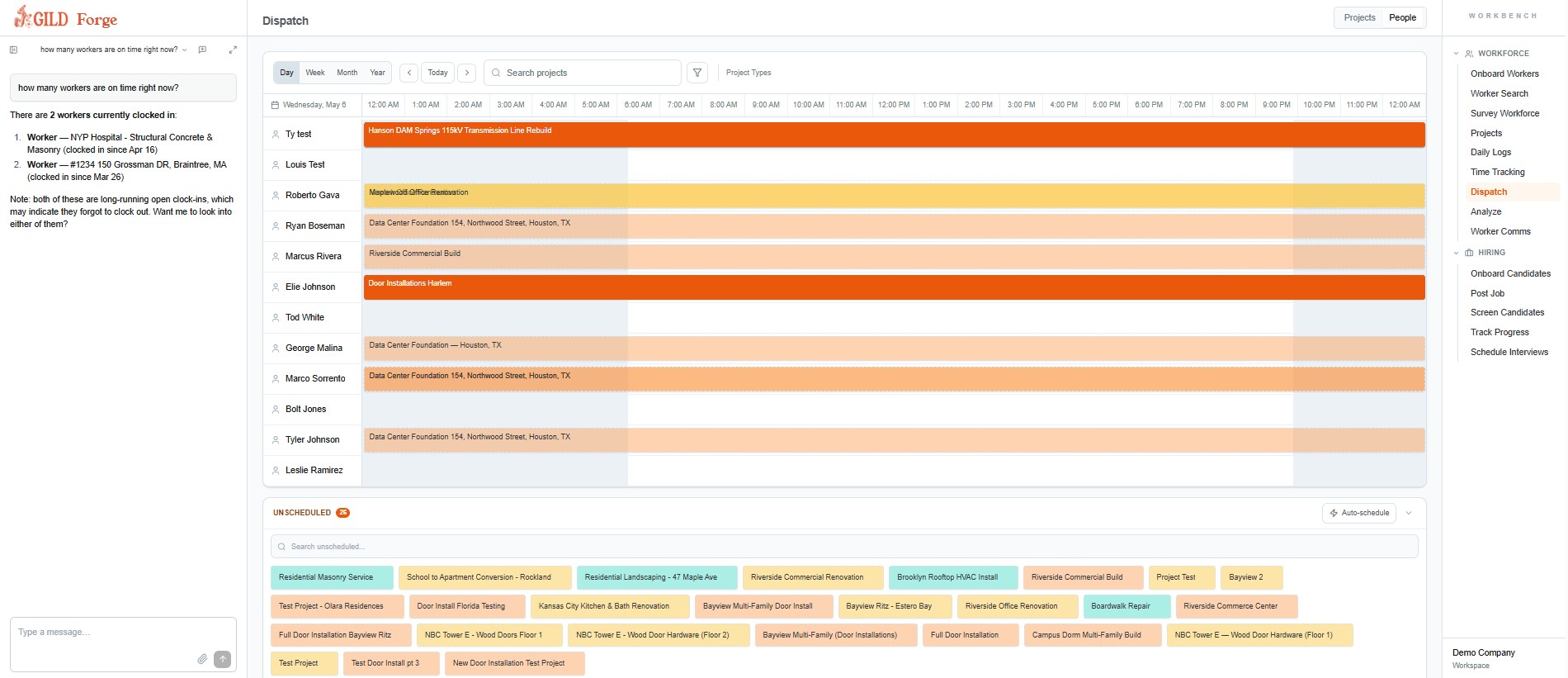
Multi-Segment Visibility For contractors operating across business units the database becomes the connective tissue. A certified operator sitting on the bench in the pipeline division might be exactly what the civil team needs on a bridge project 100 miles away. Without a unified workforce database, that redeployment never happens. The pipeline division pays bench time. The civil division pays for a sub.
Automated Availability Workers can text their availability for the upcoming week. Foremen can text crew assignments. The system absorbs all of it and surfaces a real-time view of capacity across every project and division — no spreadsheet gymnastics required.
Predictive Staffing With historical data on project timelines, crew sizes, and skill requirements, you start to see patterns. You know that a transmission project in its final two weeks will shed 12 linemen who become available for redeployment. Instead of discovering that the week it happens, you're planning for it three weeks in advance.
From Dispatch to the Field: Daily Operations and Data Capture
The same voice and text channels that built the database also become the interface for field operations.
Daily Logs Without the App A foreman texts (or calls in) a daily update: crew count on site, work completed, any issues. That becomes a structured daily log — timestamped, tied to the project, searchable. No app. No form. No end-of-week paperwork.
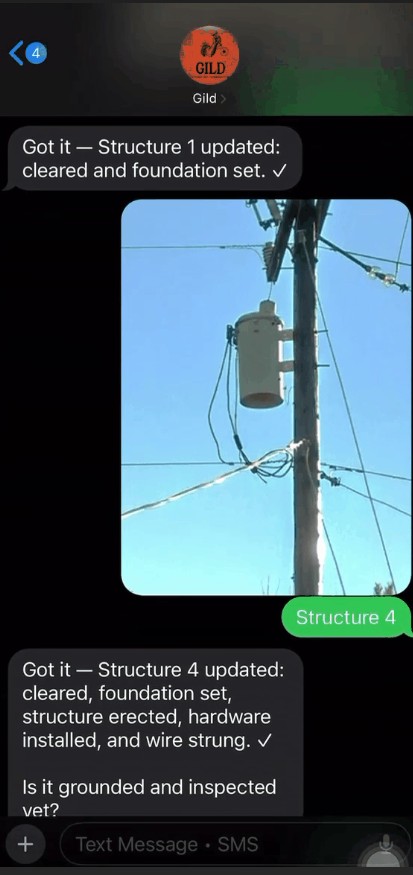
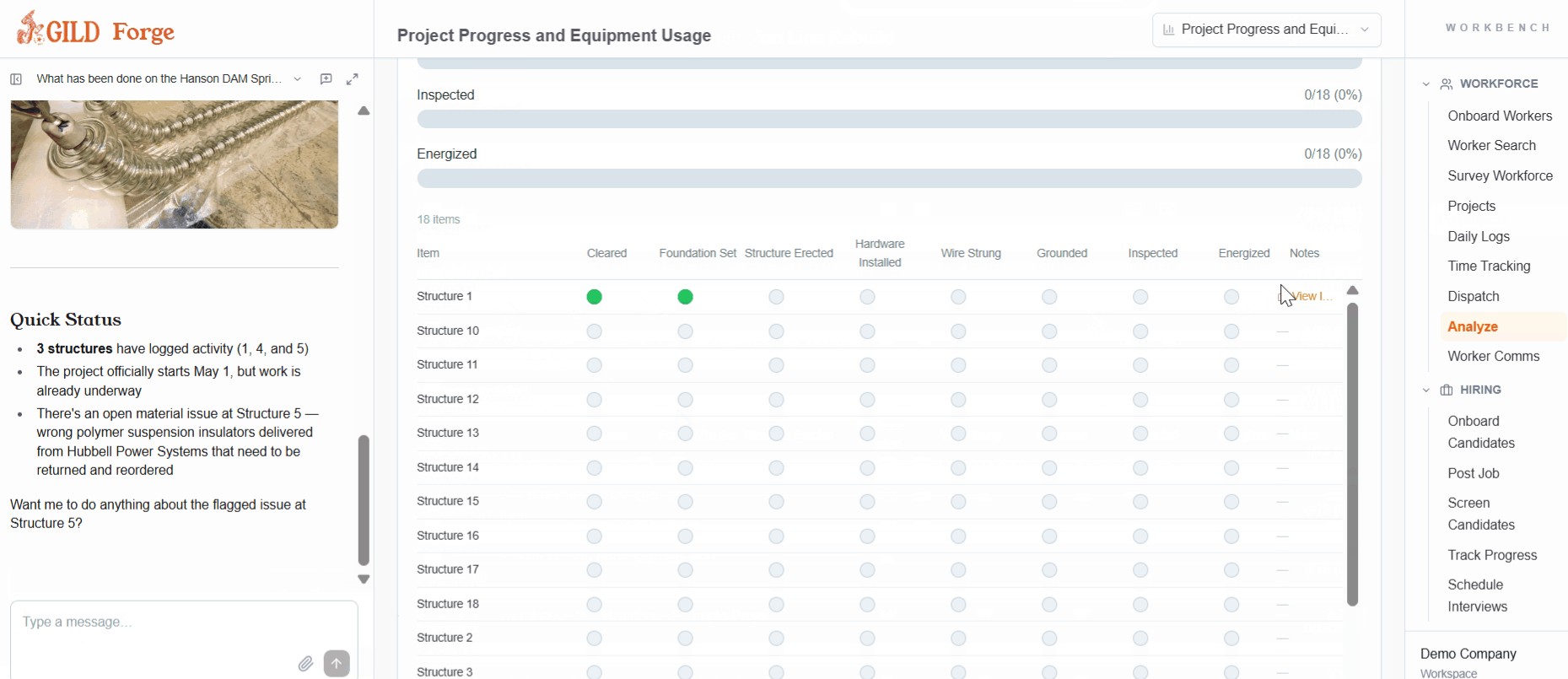
Progress Tracking Workers and foremen text progress updates throughout the day. Structures erected, cable pulled, pipe laid, panels set. Photos attached. The project manager sees real-time progress against the schedule without waiting for a weekly report that's already outdated by the time it arrives.
Time Tracking Workers text to clock in when they arrive on site. GPS confirms they're at the right location. Hours are automatically tied to the correct project and cost code. Overtime gets flagged in real time — not discovered on Friday when it's too late to do anything about it.
Safety and Compliance Toolbox talks confirmed via text. Safety incidents reported immediately through voice. Certification compliance checked at dispatch — before a worker shows up at a site they're not qualified to be on. The system won't deploy a welder to a pipeline job if their procedure qualification expired last month.
The Compounding Effect
The real power is in how these three layers compound:
Database— You finally know who your people are and what they can do
Dispatch— You put the right people on the right projects, every time
Field Ops— You capture what's actually happening on the ground, in real time
Each layer feeds the next. Field data updates the database — a worker completes a new certification on a project, it's captured. Dispatch decisions get smarter as the database grows. Field ops data validates whether dispatch decisions were right.
For a large infrastructure contractor, this isn't just an efficiency play. It's the difference between operating as a collection of disconnected business units that happen to share a logo, and operating as a single company with real-time visibility into its most valuable asset.
What This Looks Like at Scale
For a contractor with 5,000+ field workers across multiple segments:
Certification compliance goes from "we think we're good" to verified and documented in real time
Utilization rates go up because you can see available capacity across every division, not just the one the dispatcher sits in
Overtime drops because you're deploying proactively instead of reactively scrambling
Redeployment between segments becomes possible because you have a unified view of skills and availability
Daily field data means project managers know what happened today, not what someone remembers happened last week
The institutional knowledge that used to live in a foreman's head now lives in a system — and it doesn't retire, quit, or get poached by a competitor
The Bottom Line
The skilled trades workforce is the single largest line item on an infrastructure contractor's P&L. Labor is 40-60% of project costs. But most contractors have better systems for tracking their fleet vehicles than their people.
Building a real workforce database isn't a technology problem anymore. It's an adoption problem. And adoption is a channel problem. If you meet workers where they already are — on the phone, in texts — you solve adoption. Once adoption is solved, everything else follows: smarter dispatch, better utilization, real-time field data, and an operations team that can finally answer the question that matters most.
Who do we have, what can they do, and where should they be?
Your crews don't work at desks — your workforce tools shouldn't either. Book a demo to see field-first workforce management with Gild's Forge or learn more here.
Your workers won't use software that slows them down. Gild meets them where they are—via text and voice.